
At first glance it sounds like an automotive meme: cram a wind turbine into the bumper and pump electricity straight from the rushing air. Funny? Maybe. But Hyundai and Kia have filed a patent — and buried in it is a detail that wipes the smirk off your face. The Koreans aren’t trying to build a “perpetual motion machine” for an EV at all.
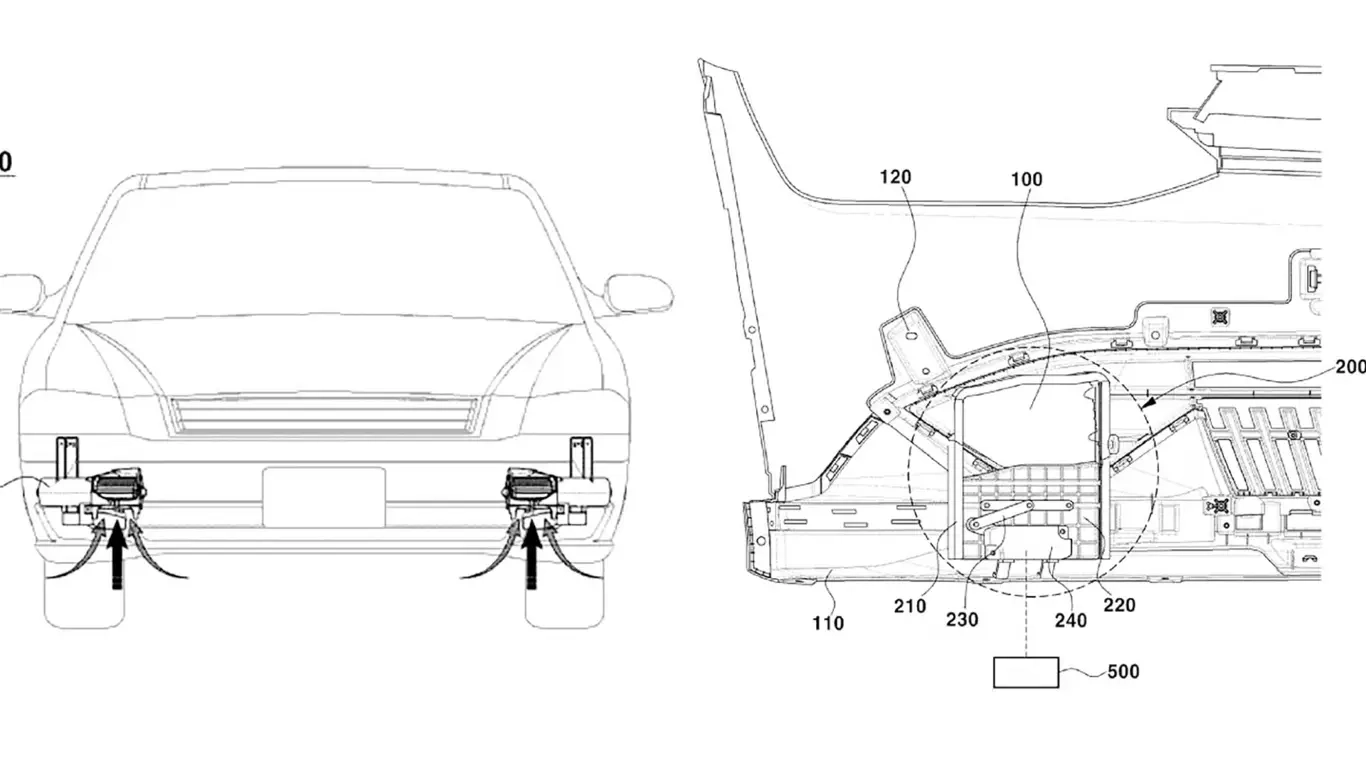
According to the US patent office, it’s all far cleverer than it looks. Behind movable flaps in the front grille sits a generator. When the airflow pays off, the flaps open, air runs through a channel, spins the generator and escapes down or out the back. When it doesn’t, the flaps slam shut so aerodynamics stay intact. No magic. Just cold engineering math.
And here’s where it gets interesting. For a pure EV the whole idea is almost always a wash. At high speed, everything the generator pulls from the air comes straight back as extra drag — the car burns more charge just to hold the same speed. Add conversion losses, and your plus turns into a minus. So forget the Ioniq 5 and the EV6. This patent wasn’t written for them.
At low speeds the math flips. Here energy use leans less on aerodynamics and more on mass, tire rolling and auxiliary systems. And Hyundai reckons that in certain modes the generator can hand a useful bonus to regen. Coasting, braking — or even simply parking nose-to-wind, letting the car sip a charge while it sits.
For a hybrid the logic is downright ironclad. An electric motor beats a gasoline engine on efficiency, and a combustion engine loves a narrow band of load and revs. So the generator could top up the battery in a way that keeps the gas engine spinning in its sweet spot — and lets the car glide longer on electric power. In an ordinary petrol car, the same system could even partly replace the alternator and feed the 12-volt network as needed.
Still — don’t hold your breath for a showroom model with a “turbine” in its nose. The patent promises nothing of the sort. Automakers file these things by the truckload to protect ideas, not to launch them tomorrow. How much energy a compact generator would really deliver — and whether it justifies all the fuss of flaps, channels and controls — is a very open question.
But the logic itself speaks volumes. With EV demand cooling, manufacturers are once again hunting for ways to stretch the life of combustion engines and hybrids. Not with a revolution — with tiny percentages of savings. And it’s often these odd-looking fixes that end up shaping the real war on fuel consumption.