
China's car market is gearing up for a fresh wave of large SUVs after the Beijing Auto Show. Models stretching around 5.2 meters and beyond are on the way from Onvo, Leapmotor, BYD, Chery, Haval, and several projects involving Huawei. The real intrigue, however, lies not just in dimensions but in pricing: some versions equipped with battery-as-a-service (BaaS) schemes bring the entry ticket down to roughly 159,800 yuan—about $22,000 to $23,000.
What separates this wave from previous flagship launches is precisely the price tag. A big crossover in China no longer demands a premium budget by default. The lower threshold already dips to 159,800 yuan, or around $22,000, if you factor in BaaS battery rental versions. For buyers, that reshuffles the entire decision-making logic. Not long ago, a large SUV almost automatically meant an expensive purchase; today, mid-range models are stepping into this size class.
One telling example is the Onvo L80. It’s a large five-seat SUV with a length of about 5,145 mm and a wheelbase of 3,110 mm. Dimensions put it close to the three-row L90, but instead of a third row the focus shifts to cargo—claimed rear volume reaches 2,600 liters. The version with a battery starts at 245,800 yuan (roughly $35,600), while the BaaS option begins at 159,800 yuan, or about $23,200.
Further down the lineup, the SGMW Huajing S also appears—a six-seat plug-in hybrid SUV developed with input from Huawei. It measures 5,235 mm long with a 3,105 mm wheelbase. The model features Huawei’s Qiankun intelligent driving system, blind orders are already open, and sales are set to launch on May 8. The expected starting price sits near 160,000 yuan, approximately $22,100.
Leapmotor D19, meanwhile, is entering the full-size segment and will be offered both as a fully electric model and as an EREV. Pricing guidance points to a start of 219,800 yuan (around $32,200), making it one of the more affordable ~5.2‑meter Chinese SUVs. Haval Menglong Plus leans into a more off-road-oriented format, offering five- and seven-seat configurations, the Hi4 hybrid system, and a preliminary price range below 220,000 yuan.
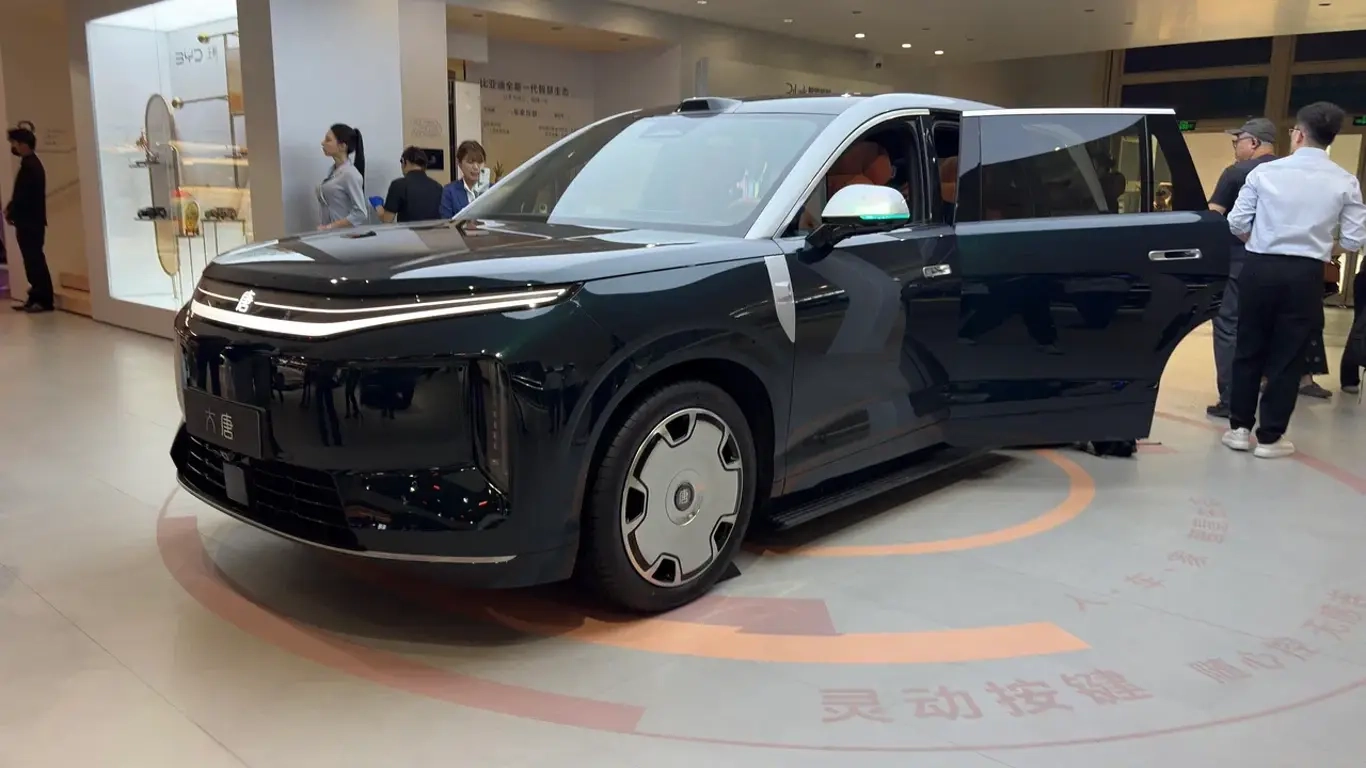
Higher up the food chain sit cars like the Li Auto L9 Livis, Nio ES9, and BYD Great Tang. Li Auto L9 Livis carries a 559,800‑yuan sticker (about $77,300). Nio ES9 is listed between 528,000 and 658,000 yuan (roughly $72,900–$90,800), though BaaS could push the entry price lower. BYD Great Tang has a preliminary estimate of 250,000–320,000 yuan, or $34,500–$44,200.
These vehicles share a common recipe: a big body, three rows or a cavernous cargo hold, a hybrid powertrain, advanced driver aids, and a driving range that in the Chinese CLTC cycle often tops 1,000 km. But such numbers deserve caution. CLTC is notably more optimistic than Europe’s WLTP, and real-world results depend heavily on speed, temperature, and driving style.
BYD Sea Lion 08 sits more in the upper mid-size SUV bracket but still follows the trend. At 5,115 mm long, it will be offered in BEV and PHEV guises, with the electric version expected to deliver up to 900 km CLTC and rear-wheel steering. Wuling Starlight L isn’t technically a full-size SUV—its length is about 4.98 meters—yet it matters as a more affordable three-row alternative. Expected pricing is around 100,000–130,000 yuan, or $13,800–$17,900.
Demand for SUVs in China is already plainly visible in March data from China EV DataTracker. Tesla Model Y topped the segment with 39,827 sales and a 5% share. Second place went to Li Auto i6 with 24,198 units, followed by BYD Yuan UP at 21,538. Rounding out the top ten were Geely Atlas L (17,402 sales), Deepal S05 (16,881), Nio ES8 (16,255), Volkswagen Tayron (15,897), Toyota Frontlander (15,470), Toyota RAV4 (14,662), and Volkswagen Tiguan L (14,581).
That list shows clearly how China’s SUV market has become technologically mixed—BEVs, EREVs, PHEVs, and conventional petrol models stand side by side. Tesla Model Y still holds the lead, but right behind it are Chinese electric and hybrid SUVs, not just compact ones but increasingly larger offerings.