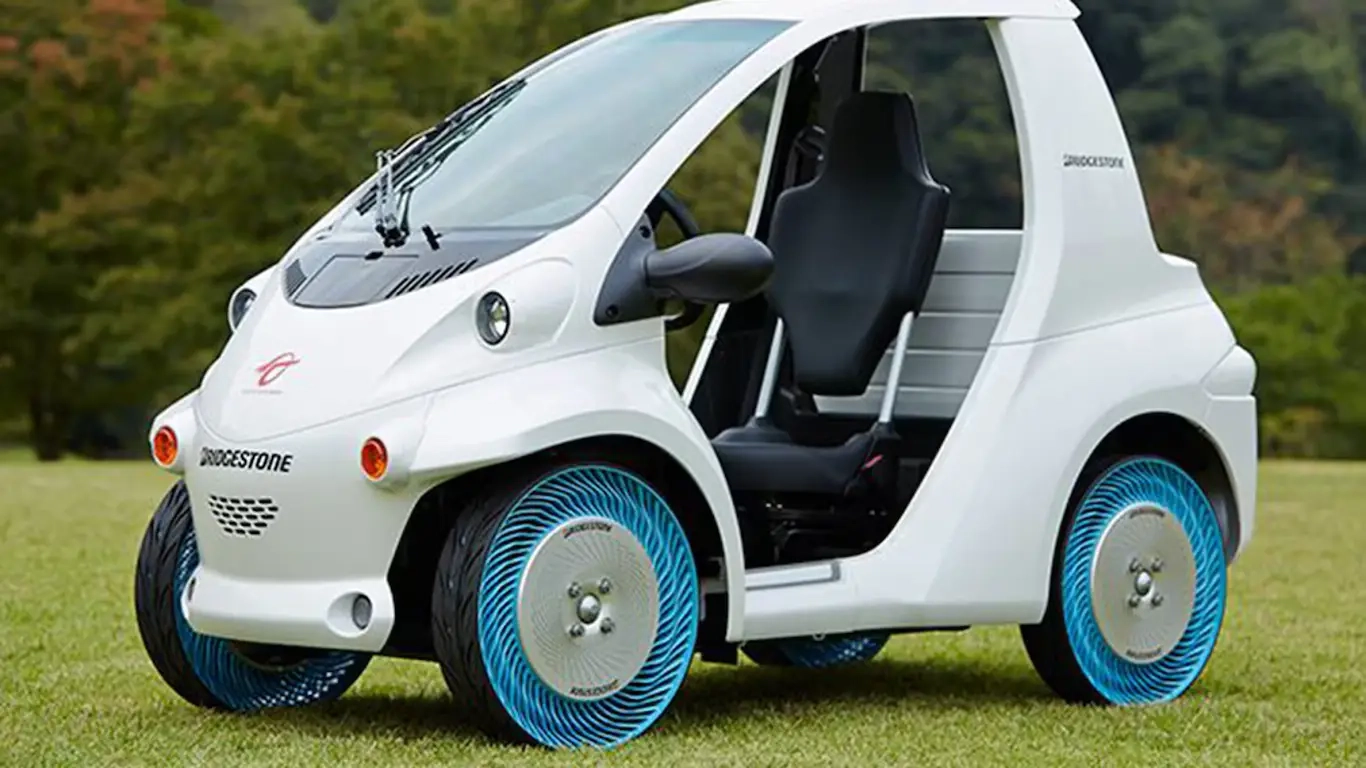

Eighteen years. That’s how long Bridgestone spent taking its airless tire from prototype to real-world road. Now AirFree has finally stepped off the show stand: in the Japanese city of Higashiomi it has been fitted, for the first time in the country, to a municipal self-driving vehicle — not for the length of a trial, but as a permanent service.
The tires went onto a green slow-mobility shuttle, the Oku-Eigenji Keiryu Car — an unhurried golf-cart-style platform that has been carrying people along a route of roughly 4.8 km since 2021. The service launched on July 8 in the Oku-Eigenji district, where more than 60% of residents are elderly. Here it isn’t speed that matters but predictability: the vehicle has to show up on the line every single day and move locals and tourists without cancelling runs over minor faults.
AirFree needs no air at all. The load is held not by pressure inside the casing but by a spoke-shaped load-bearing structure made of thermoplastic. Which means no familiar puncture risk, no routine pressure checks, and fewer reasons to stop mid-route. For a private car this still looks exotic. But for small shuttles, industrial machines and district transport the math is different: downtime often costs more than the tire itself. And there’s a detail that’s hard to miss — the spokes are painted in Bridgestone’s signature Empowering Blue, so the shuttle stays visible even at dusk.
The self-driving shuttle in Higashiomi follows an electromagnetic guide line laid straight into the road surface. This isn’t a robotaxi reading the world through cameras and lidar: the system is simpler and built for a fixed line. And the weak point here isn’t the much-hyped “artificial intelligence” but far more down-to-earth things — the tire, the sensor, the servicing, the readiness to roll out in the morning.
People at the launch confirmed it: with AirFree the warning indicators trip less often — and until they’re cleared, the vehicle simply won’t switch into automatic mode. There was talk of less noise and less vibration too. One of the drivers, Masatoshi Nakaya, put it plainly: “Compared with air-filled tires, the number of times the warning light comes on has dropped significantly.”