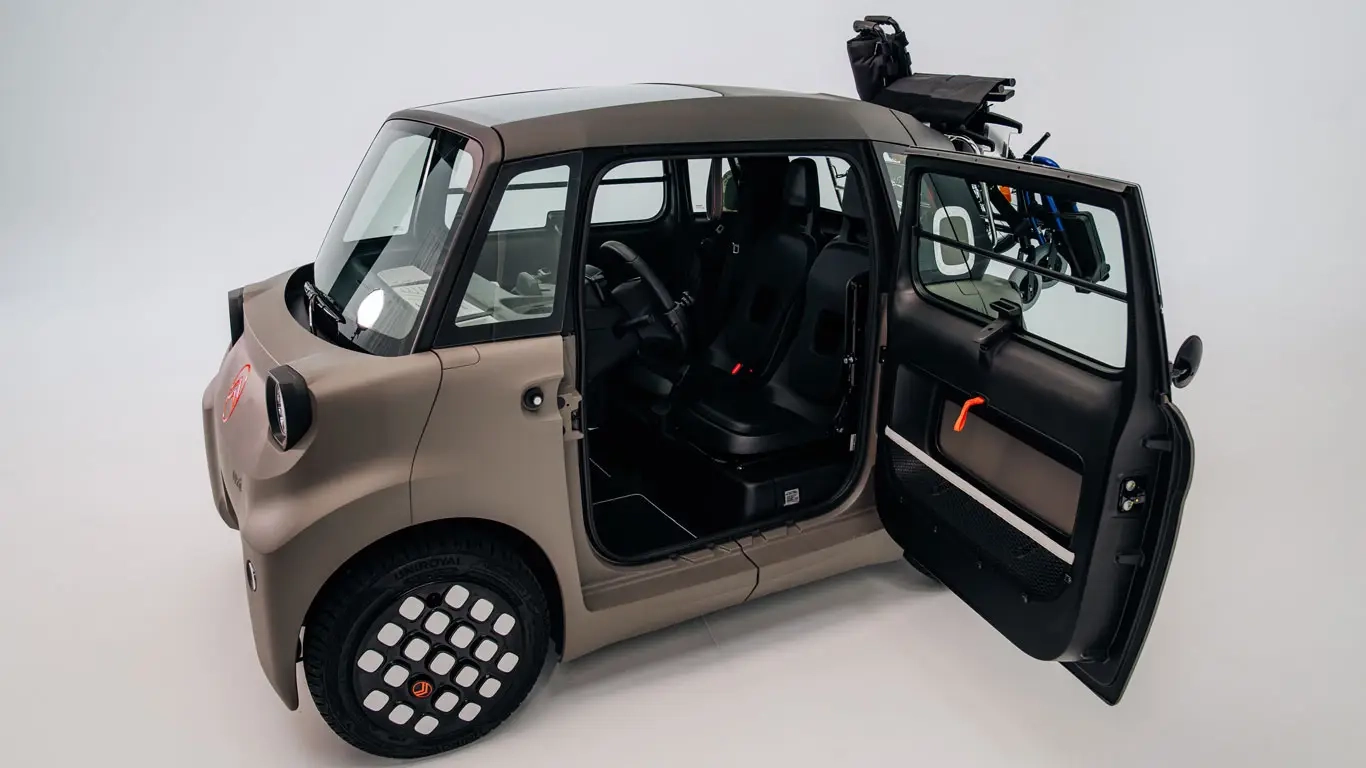

Nobody promised the Citroën Ami an easy life, and the little quadricycle just took on a job most cars can't handle. Germany has opened orders for the electric Ami[for]all — a version converted for people with reduced mobility in their lower limbs. The driver's door now swings open to 90 degrees, and the car gets a pull-out transfer board, a support loop, hand controls for throttle and brake, plus a rotating knob on the steering wheel.
Here's the twist: this isn't a separate version built from scratch at the factory. The buyer first orders a regular Ami in the trim of their choice, then reaches out to Mobilcenter Zawatzky for an individual conversion quote. Only after production does the quadricycle head off for certified TÜV conversion work — and only then does it reach the Citroën dealer. Leasing simply isn't an option here: it's cash purchase or nothing.
The transfer process is worked out down to the details. The driver moves from the wheelchair into the regular seat, and the wheelchair itself can either be folded up and secured on the passenger seat, with the wheels tucked by the footwell, or mounted on the aluminium rear rack. In the second case, there's still room for a passenger inside. The pedals stay exactly where they were, so anyone without mobility limitations can drive the car too — it remains fully usable by everyone.
The hardware hasn't changed: top speed stays at 45 km/h, with up to 75 km of range on the WMTC cycle. A full charge from a household 230V outlet takes around four hours. In Germany, you can get behind the wheel of this light quadricycle from age 15, as long as you hold an AM licence.
The pricing is where things get interesting. The standard Ami starts at €7,990 in Germany, but how much the conversion adds is anyone's guess. The price isn't published — the specialist firm puts together an individual quote for every customer. So there's simply no way to estimate the total cost of the ami[for]all from Citroën's base price list alone.
The project has taken its time getting here: first shown as a prototype, the conversion has been offered in France since 2023. Now it's finally reached Italy and Germany too.