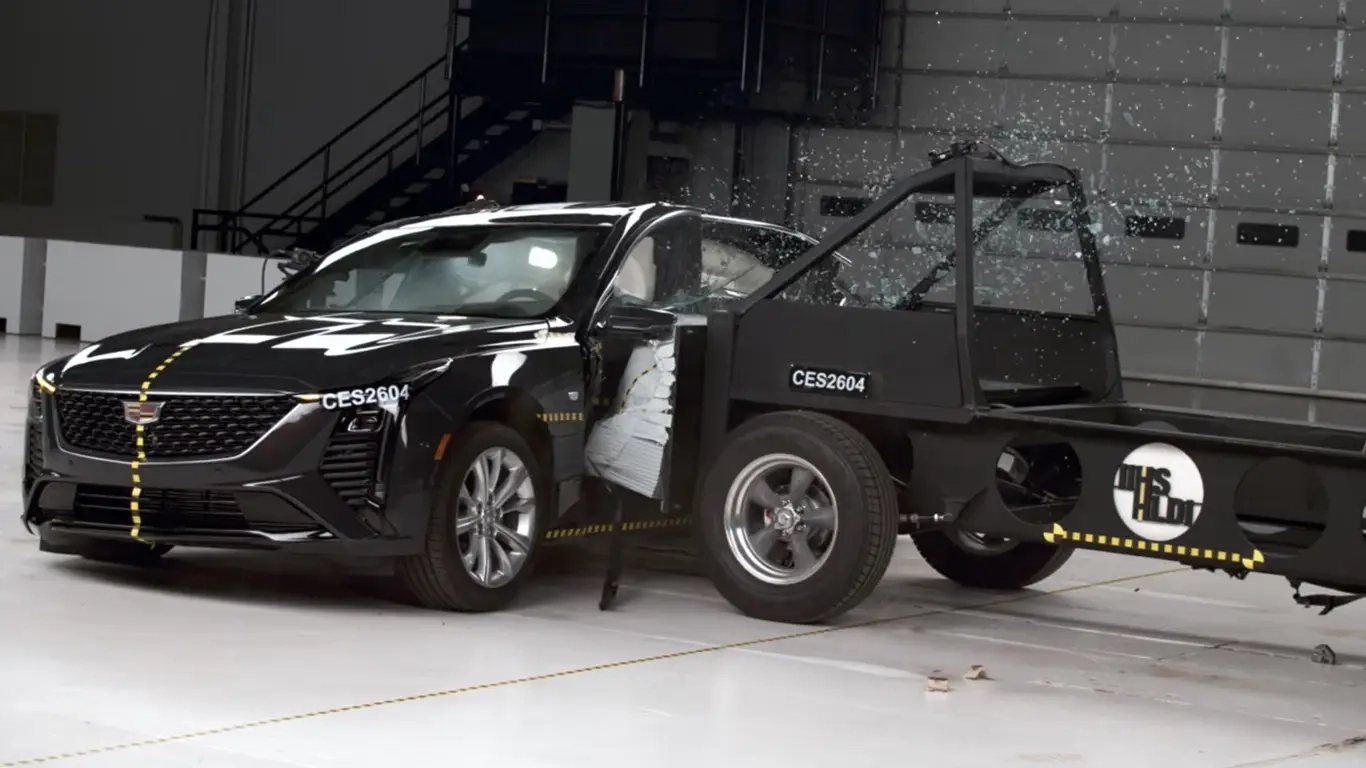

Nobody saw this coming from a premium sedan: the 2026 Cadillac CT5 scored Poor in two crucial IIHS tests — the updated side-impact test and the moderate-overlap front test. But the number that really stands out came from the side test: the driver dummy's head slid below the side curtain airbag and struck the door structure, with peak head acceleration hitting 161 g and a HIC-15 of 1,282.
In this test, a barrier weighing around 1,905 kg, built to mimic a modern SUV, strikes the vehicle's side at roughly 60 km/h. IIHS rated driver head and neck protection Poor — the lowest possible score. The rear passenger fared far better: head, chest and pelvis measures all earned Good. Structural performance in the side test was rated Marginal.
You'd expect the front test to redeem the sedan. It didn't. The structure and driver measures did score Good, but IIHS recorded Poor for the rear passenger's head and neck, and Marginal for chest protection. It was the second row that dragged the overall front rating down to Poor.
And that's not all. Front crash prevention involving another vehicle scored Poor, pedestrian detection came in at Acceptable, and the seatbelt reminder earned Marginal. Headlights tell a split story: the standard LED units on some trims got Marginal, while the adaptive headlights on Technology and Platinum packages scored Poor. So the claim that it was the "base headlights" that dragged down the score simply isn't accurate.
How can American "stars" and failing IIHS scores coexist? Simple: NHTSA and IIHS run different programs, crash scenarios and methodologies. A five-star NHTSA rating can't be treated as equivalent to an IIHS Good score, or used to dismiss the other agency's findings. NHTSA itself notes that its Overall Vehicle Score is built from its own frontal and side tests plus a rollover resistance rating.
Does this mean the CT5 is headed for early retirement? There's no basis yet to link the IIHS results to an accelerated end of production. General Motors officially confirmed development of a next-generation Cadillac CT5 back in October 2025 — but that announcement named neither 2028 nor the 2029 model year, nor any accelerated wind-down of the current car.
So the next thing to watch is Cadillac's response. If the automaker revises the side curtain airbags, seatbelts, AEB software or body structure on the current CT5, IIHS could re-test the updated car. For now, the two Poor ratings are a confirmed test result — an early "retirement" for the sedan remains nothing more than speculation.