
On July 25, Hyundai Motor Group was still talking about Physical AI as a strategy tying together cars, robots and “smart” factories. Nice words about the future. Eighteen days later, the company put numbers from already-running systems on the table — and that turned out to be far more convincing than any slide deck: the time spent searching for relevant safety cases and reviewing analytical materials dropped by roughly 90 percent, while AI-driven production logistics algorithms cut unplanned downtime by about 86 percent.
That’s the real shift here: Hyundai is moving AI out of corporate-experiment territory and into the everyday work of designing, building and servicing cars. On the factory floor, a computer vision system reads VINs and cross-checks each vehicle against production records — in real time, no pausing to think it over. The technology already runs across roughly 70 processes at Hyundai and Kia plants in Korea, the United States, Europe, India and the Asia-Pacific region. The company puts the annual savings at 5.24 billion won, or around $3.9 million.
In service, the payoff is measured in time, and it’s counted in minutes, not percentages. An LLM-powered support system helps technicians search for fault patterns and recommendations across technical documentation: Hyundai estimates response time has dropped by roughly 42 percent. Processing a customer review fell even further — from 35 minutes down to about 5. Nearly a sevenfold difference. Starting in September 2026, the company plans to move to full automation of drafting review responses, while keeping the existing mechanism that flags cases needing a human’s attention.
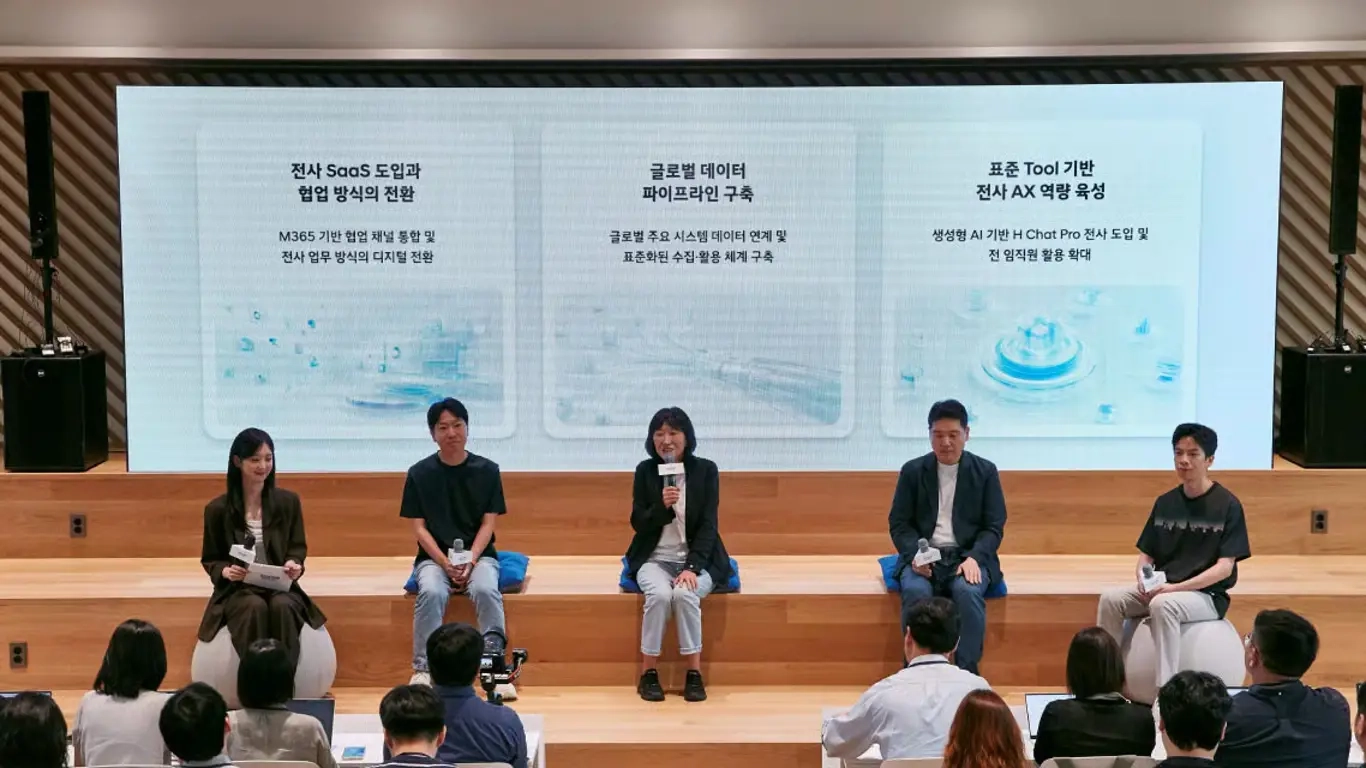
Meanwhile, the in-house H Chat Pro platform keeps scaling up. Through a secured environment, employees get access to ChatGPT, Gemini and Claude, and the number of active users topped 30,000 by July — about 80 percent of Hyundai Motor and Kia’s office staff. The company also points out a rise in AI agents built by employees who have never written a line of code before. People who, until yesterday, hadn’t touched software development.
Jin Eun-sook, President and Head of ICT Management at Hyundai Motor Group, put the company’s position this way: “AI is certainly an important technology, but ultimately it’s a tool that companies need to use. What matters isn’t simply having the technology — it’s how quickly an organization can understand new technologies, including AI, apply them to its work and business, and turn them into an internal source of competitive advantage. Building on our ongoing digital transformation, Hyundai Motor Group is expanding AI-based transformation by integrating AI and other intelligent technologies.”
The next milestone to watch is September’s automation of customer review processing. But the bigger goal has already been declared: linking accumulated data and existing AI systems with vehicles, robotics and manufacturing under the Physical AI umbrella. Back in July, Hyundai described this model as a shift from standalone smart devices toward entire AI factories and, eventually, connected urban infrastructure.