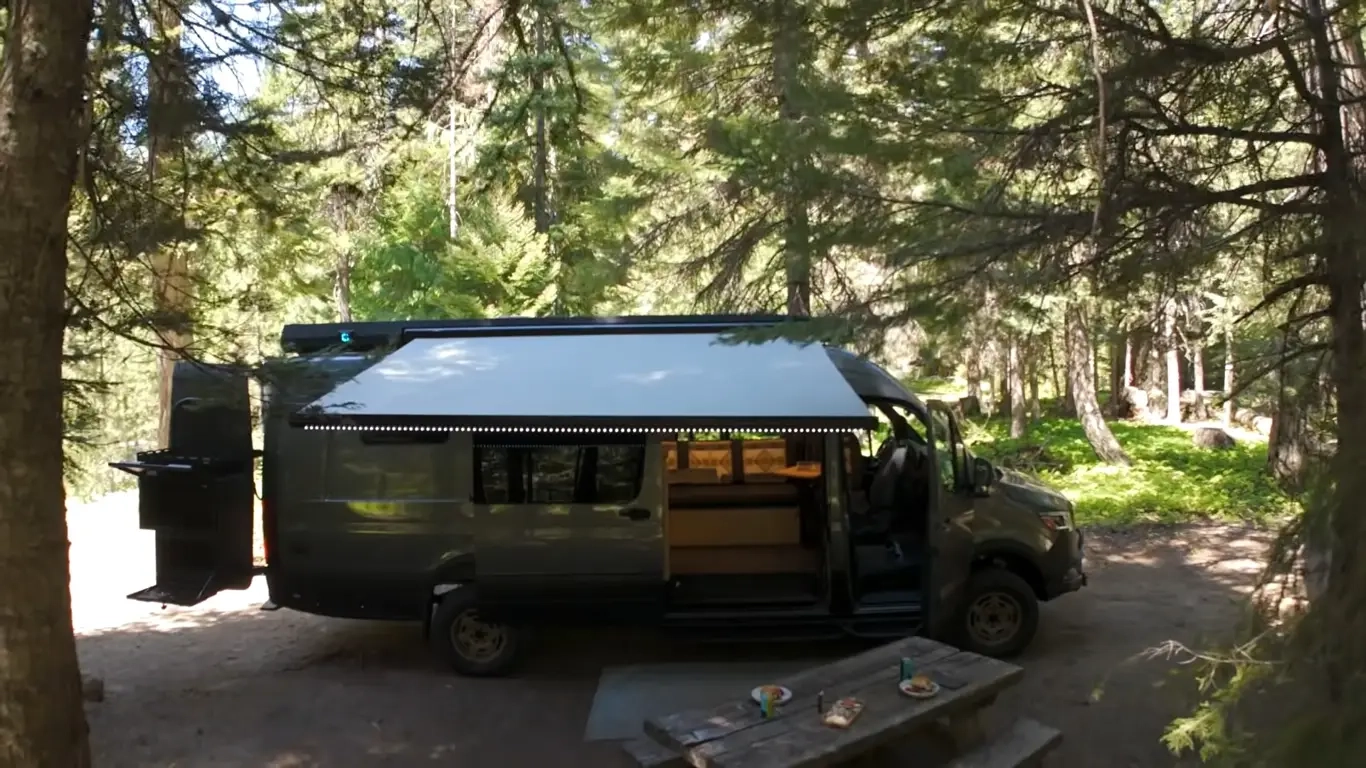

Generators are the usual answer in a camper van. The new Earl Gray skips that answer entirely — instead, it leans on the sun, a battery, and some clever engineering. Four 100 Ah batteries at 48 V add up to roughly 19.2 kWh of nominal energy storage — and that number explains, better than anything else, why this new Earl Gray exists at all. Built by Elementum Adventure Vehicles on a 2025 all-wheel-drive Mercedes-Benz Sprinter with a 170-inch wheelbase, this custom camper isn’t really meant for a spot at a proper campground — it’s built for extended off-grid living, far from civilization.
The power system is hidden under a three-person couch, with no hint of the small power plant sitting underneath. Besides the batteries, it packs a 3,000 W inverter, and there are three ways to charge it: 800 W of rooftop solar panels, shore power, or DC-DC charging straight from the vehicle. That 19.2 kWh figure isn’t a manufacturer claim — it’s a calculation based on the published specs of the four 48 V/100 Ah modules; actual usable capacity depends on the battery design and the system’s settings.
For Elementum, this approach is no longer an experiment — it’s a scalable architecture. The company’s other Sprinter, the Viento, uses a 17 kWh battery, a 3,000 W inverter, and the same 800 W of solar, while the heavier Waimea steps up to a 30 kWh pack and a 5,000 W inverter. On paper, Earl Gray lands right between the two — not the modest option, but not the flagship either.
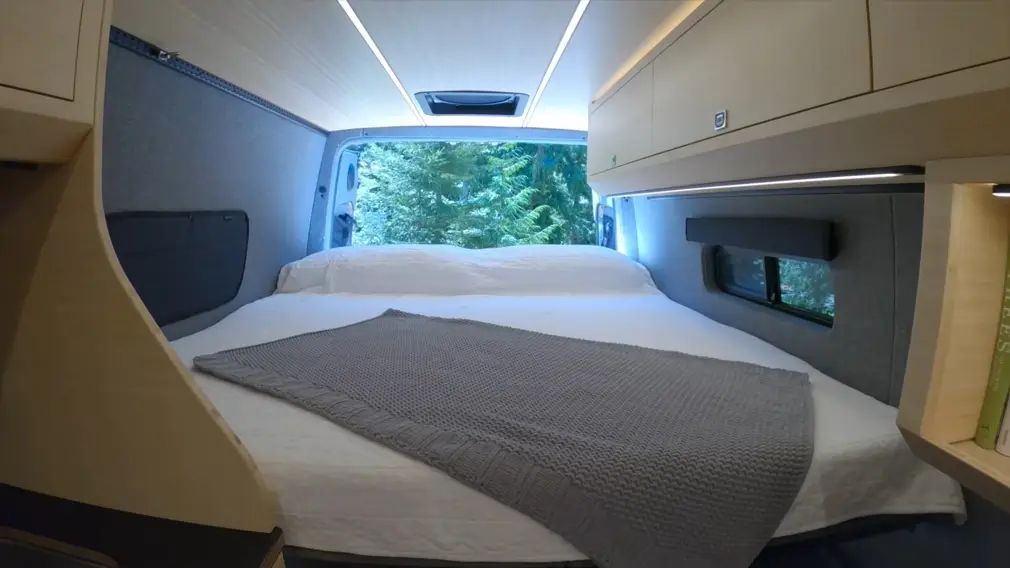
Going off-grid demanded more than just space for the electronics. In the rear, instead of a fixed bed, there’s a Murphy bed setup: two platform sections fold vertically against the wall, freeing up the walkway. Underneath sits part of the plumbing system, including a freshwater tank, a water heater, and an outdoor shower. The mattress rests on a Froli system, which creates an air gap beneath the sleeping area — a small detail, but exactly the kind of thing that adds up to a week of off-grid living without a stop.
The 53-inch (134 cm) galley includes an Isotherm Cruise 130 fridge, a two-burner induction cooktop, and a sink. And this is where the whole concept really shows its hand: induction cooking isn’t a backup power draw for lights and gadgets anymore — it’s a full household electrical system on wheels.
Outside, the logic is the same — ready for anything. There’s an Owl Vans bumper with a Warn winch, Baja Designs auxiliary lights, ladders, a rear platform, and a separate cargo box. The solar panels sit in Elementum’s own roof rack. The company fits similar 800 W solar setups on other Sprinter builds too, including the new Waimea and Zephyr.
Earl Gray’s price hasn’t been revealed, so comparing it to production campers isn’t really fair yet. But the technical shift is already visible: energy storage in builds like this is starting to rival a small home battery, and interior layouts are being designed less around a permanent bed and more around giving the van back its open floor space during the day.
The next thing worth checking won’t be another trim detail — it’ll be the actual usable battery capacity and the size of the water tank. Those two numbers will show just how far Earl Gray’s claimed off-grid range really goes beyond an ordinary weekend camper.