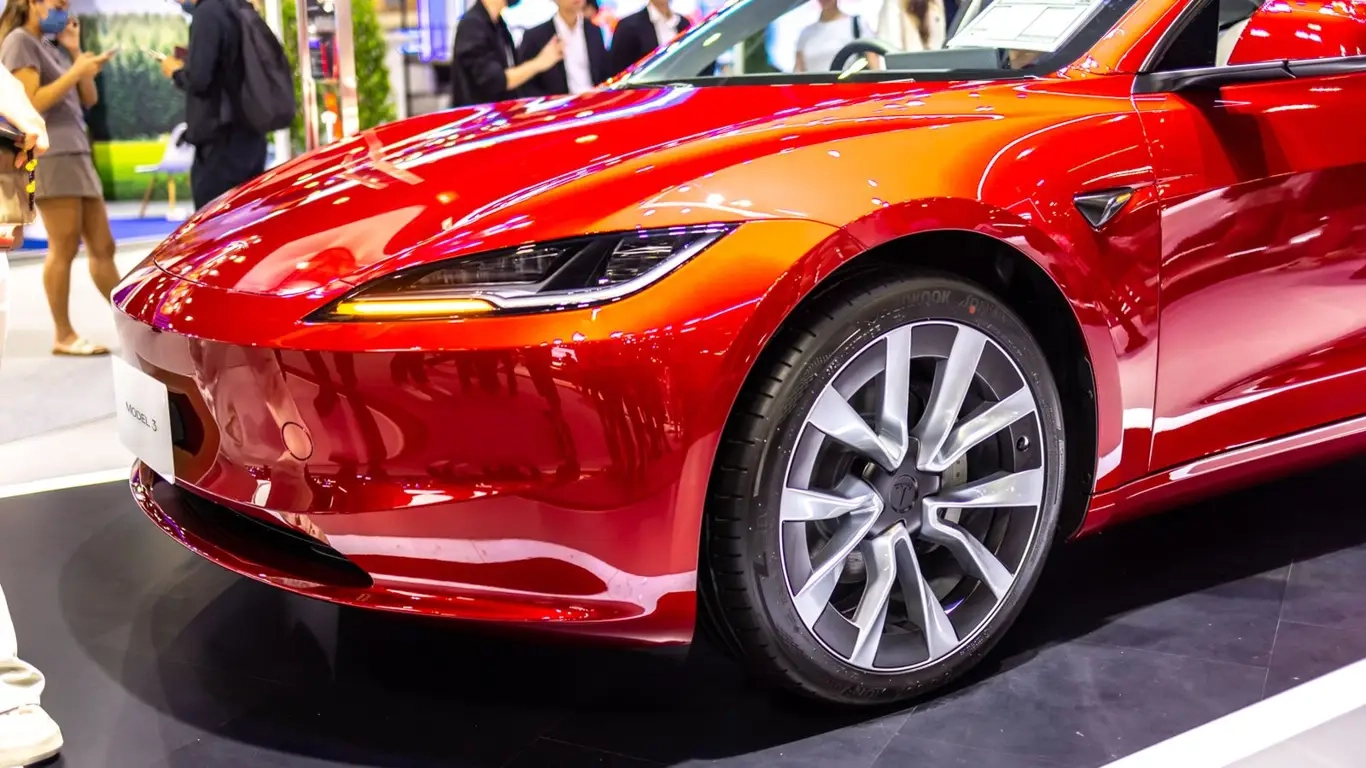

694,353 km on the odometer, the original traction battery, and both original electric motors still in place — but calling this Tesla Model 3 “nearly new” would be a stretch. In AutoWeek's March test, the six-year-old Long Range AWD showed 71% battery SoH, while the car's own BMS estimated a more modest 68%. And through it all, the car kept commuting daily between the Netherlands and Germany.
Owner Josef Henar didn't baby the battery for a second. He got nearly half his energy from Superchargers, and on long trips he'd often charge to 100% if he was heading straight back out. Range, he says, dropped from about 450 km when new to 350–380 km now. That figure doesn't quite match the 300–350 km cited in a later Spanish retelling of the story — but the original test is the one to trust.
Here's where it gets interesting: the first thing to really wear out wasn't the high-voltage battery at all. Inspection found three completely torn rear motor mounts, early-stage cracks in the front mounts, worn bushings and suspension arms, play in the rear transmission, and heavy corrosion on the brake discs. The upper control arms, for what it's worth, had already been replaced more than once.
The owner insists the brake pads are still the factory originals. AutoWeek confirms the battery and motors are original based on service history, but the pads' origin can't be verified by a visual check alone. Regenerative braking really did mean the mechanical brakes barely got used for years — and corroded discs were the trade-off.
Over six years, maintenance excluding tires ran to roughly €7,500. That covered work on the suspension, air conditioning, parking sensors, brake components, glass, and other parts. Which brings a useful correction to the “700,000 km with no repairs” version of this story: the battery and motors really didn't need replacing, but ordinary mechanical wear never took a day off.
Does 68–71% SoH mean the battery is “dead”? Not even close. For context, Tesla currently warranties the battery on today's Model 3 Long Range/Premium AWD in Europe for 8 years or 192,000 km, provided at least 70% capacity is retained. That's a warranty threshold, not a shutoff command. And the mileage on this AutoWeek-tested car already runs more than three times past that warranty's distance limit.
One car doesn't prove the durability of every Model 3. But the case lines up neatly with broader degradation data on the Tesla Model 3 and Model Y, where capacity loss also turned out to be non-linear: a fast initial drop, followed by a marked slowdown. Here, extreme mileage pushed the battery down to nearly 70% — and the car is still driving.
What's left is an economic question. Mechanic Carrec sees the battery's future behavior as harder to predict, while the car simultaneously needs suspension and motor-mount repairs. The owner has no plans to stop — so the miles beyond 700,000 km will decide which gives out first: the original high-voltage battery, or the financial case for continuing to fix it.