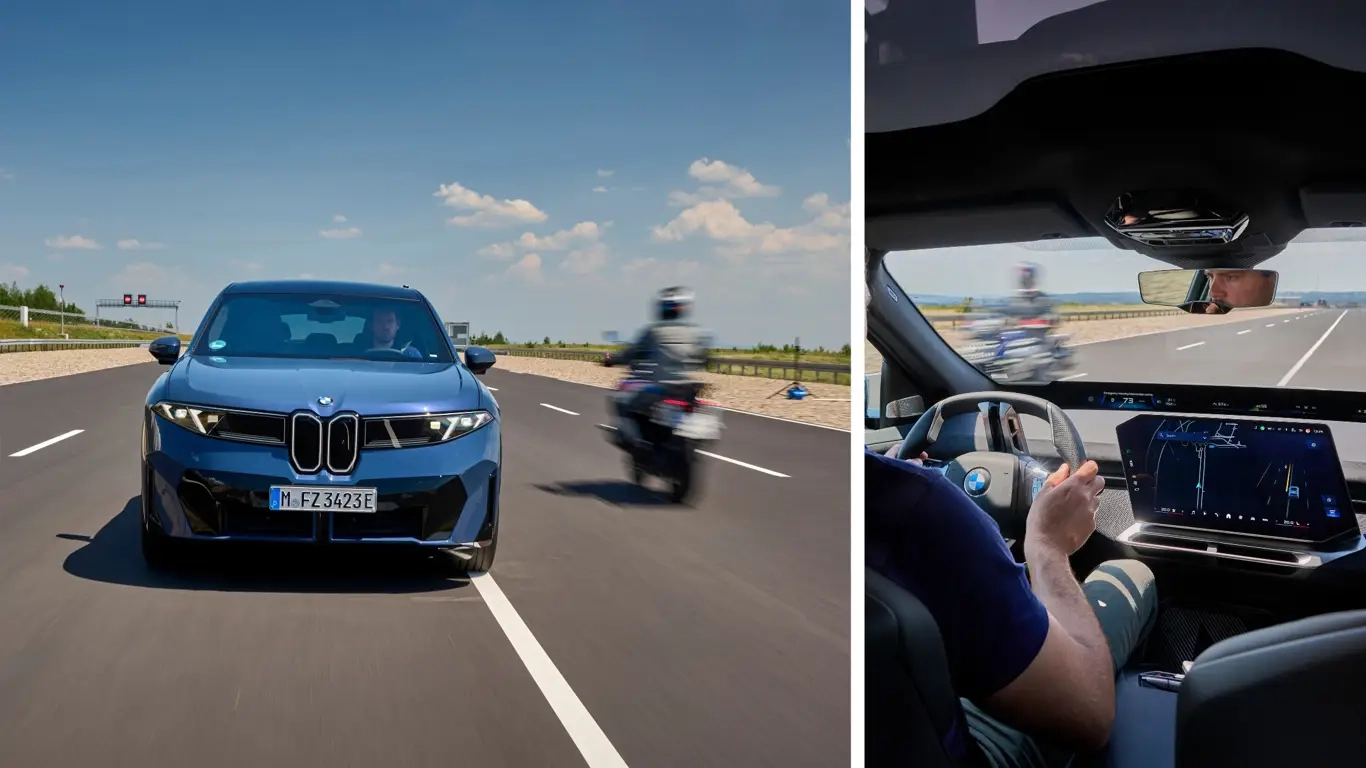

Nobody saw this coming — BMW just backed up its latest safety announcement with real-world numbers instead of lab tests. Over a single month, 1.3 million previous-generation BMWs, whose owners agreed to share data, covered 1.6 billion km across Europe. The systems issued around 8 million warnings and stepped in on their own — braking or steering — 243,977 times. Simple math: one warning every 200 km, one active intervention every 6,600 km. And only 3 % of the time did a warning actually escalate into the car taking over. One caveat worth stating upfront: this is BMW's own data on potential collisions, not a database of confirmed crashes.
Neue Klasse pushes the scenarios even further. Emergency steering can now dodge an obstacle within the lane or pull the car away from a side impact, the Emergency Brake Assistant has gained an evasive-maneuver mode, and the parking system can brake for obstacles to the side, not just behind. A separate function watches for pedal mix-ups: if an obstacle sits closer than a meter at speeds under 2 km/h and the driver suddenly floors the accelerator, the car simply stops. The scenarios are laid out in BMW's own demonstration.
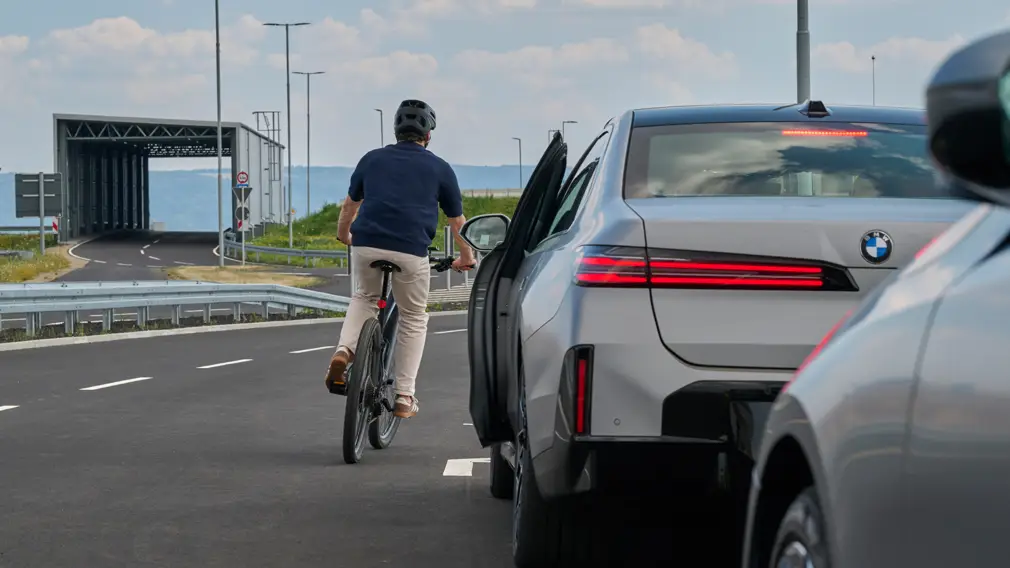
All of this ADAS logic now runs through a single water-cooled brain — the “Superbrain of Automated Driving,” with roughly 20 times the computing power of the previous architecture. But here's the paradox: the smarter the system gets, the less BMW wants to remove the driver from the loop. The bet is on Level 2 and Symbiotic Drive working together, not full autonomy — a deliberate steering input, an active turn signal, or a glance over the shoulder all help the car tell a conscious maneuver apart from a mistake.
Door safety has turned into a two-sided problem. On the Chinese-market iX3, BMW had to redesign the door handles to meet tougher emergency-access rules. Now the European architecture is solving the opposite challenge — keeping the door from opening too soon.