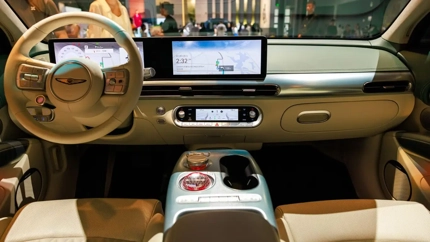

XPeng has just moved into one of the riskiest phases of testing for its Robotaxi — and this time, there's no human in the car at all. The vehicle, running second-generation VLA, has secured a permit in Guangzhou for remote testing with no safety driver in the driver's seat. The cars will be allowed to operate on approved urban roads across several categories, with emergency intervention shifted from the cabin to a remote center — the first time responsibility for safety has left the vehicle entirely.
Guangzhou's rules separate road testing, demonstration operation, and commercial service. Highly automated vehicles are permitted a remote safety officer — but only after clearing the required tests and approvals. And this is no longer a one-off prototype: XPeng's Robotaxi has moved well past the lab-experiment stage.
The company rolled out its first pre-production unit in Guangzhou in May. Built on the production GX platform, it runs four in-house Turing processors with a combined effective output of 3,000 TOPS and skips LiDAR and high-definition maps entirely. XPeng had planned to begin pilot passenger operations in the second half of 2026. By August, the company reported more than 2,000 internal test rides — the count is now in the thousands, not the dozens.
The next goal is even bolder: shifting to passenger service in 2027 with no safety officer in the car at all. The remote-testing approval just granted closes out an intermediate step between human-supervised testing and that kind of operation.
But the most interesting part isn't the permit — it's the architecture. XPeng says a single family of models powers both its production cars with L2 driver-assist and the development of its L4 Robotaxi. Regular production vehicles began receiving the second-generation VLA in March, while the Robotaxi version evolves on the same underlying stack. Still, XPeng's talk of “end-to-end capability from L2 to L4” doesn't turn a consumer G6, G9, or P7 into a Level 4 vehicle. Shared architecture isn't the same as shared capability.
In the official specifications for its production cars, the system is explicitly described as a driver-assistance package that requires constant human oversight. That's exactly why this stage matters more than any splashy L4 label: XPeng is, for the first time, carrying the same software foundation from a production driver-assist system into a car with an empty driver's seat on public roads.
What remains to be tested now isn't just the quality of the algorithm, but remote redundancy, safety, and the system's ability to handle rare road situations with no one in the cabin.
Tarantas.news previously reported that Nevada authorities granted Tesla a permit for driverless passenger service on the Las Vegas Strip. In its first phase, the fleet is capped at ten vehicles.