
Motor up, hydrogen tank down. That’s the choreography a freshly published Subaru patent lays out for what should happen inside a fuel-cell car during a severe crash. The document was published on August 20, 2026, but application US20260241808A1 is dated all the way back to May 15, 2023 — so this isn’t some random sketch, it’s the continuation of work Subaru has clearly been chipping away at for years. The problem it tackles is specific: how to keep the electric drive unit and the hydrogen tank mounted under the floor from tearing into each other on impact.
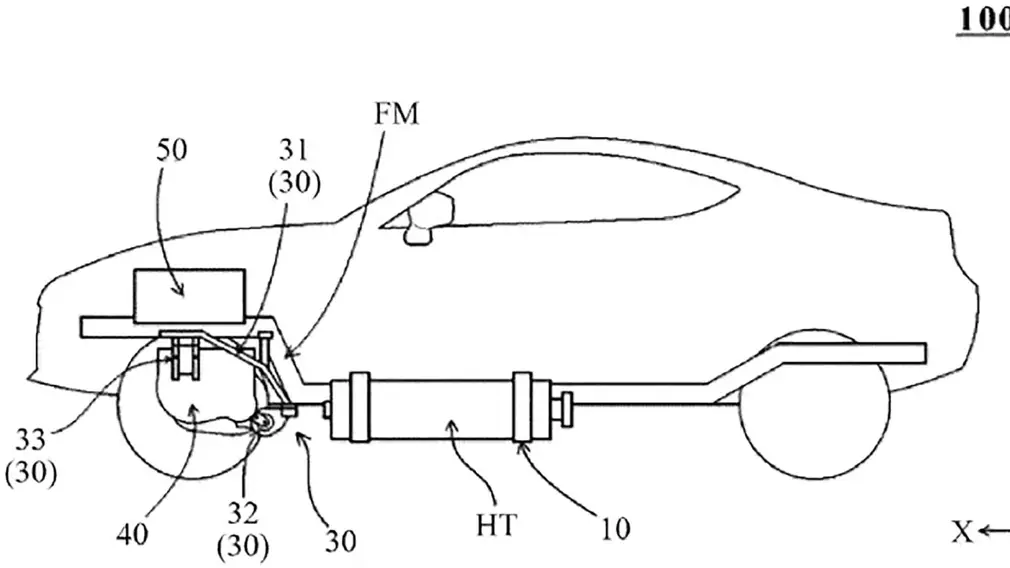
In the proposed layout, the tank sits lengthwise roughly along the vehicle’s centerline — right where the central tunnel would be. The patent ties that placement directly to the need to fit all-wheel-drive hardware into an already crowded package. The electric motor sits ahead of the tank, and one of its mounts has a deliberately weakened section — and that’s not a flaw, that’s the entire point.
In a calculated impact, that mount is designed to fail in a controlled way. The rear of the motor assembly is then free to rise, while the hydrogen tank simultaneously drops and slides underneath the drive unit. The two heavy components part ways instead of colliding. The goal here isn’t to bolt the tank down no matter what — it’s to give it a pre-planned escape route.
And there’s more. This new filing isn’t the only one of its kind from Subaru. The same inventor, Aiko Hiravaka, has a track record of fuel-cell-related patents: a layout for moving the drive unit relative to multiple hydrogen tanks was published back in 2022, and another arrangement protecting the battery, fuel cell, and hydrogen system followed in 2024. Yet another FCEV design earned a US patent in February 2026.
That track record changes how this story should be read. This isn’t an isolated sketch — it’s one entry in an ongoing series of engineering work around packaging and passive safety for a hydrogen-powered vehicle. Still, that’s not enough to say Subaru has a production fuel-cell model coming. The patent exists; the promise of an actual car doesn’t.
One thing worth not confusing: two very different technologies are in play. In 2024, Subaru, Toyota, and Mazda jointly announced a multi-pathway approach to decarbonization and mentioned liquid hydrogen among the potential carbon-neutral fuels for internal-combustion engines. This new patent is about something else entirely — it describes an FCEV, where hydrogen feeds a fuel cell that generates electricity, and an electric motor turns the wheels. It’s a fundamentally different setup, and the two shouldn’t be mixed up.