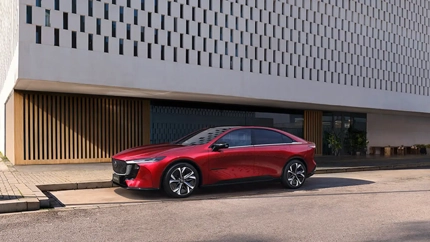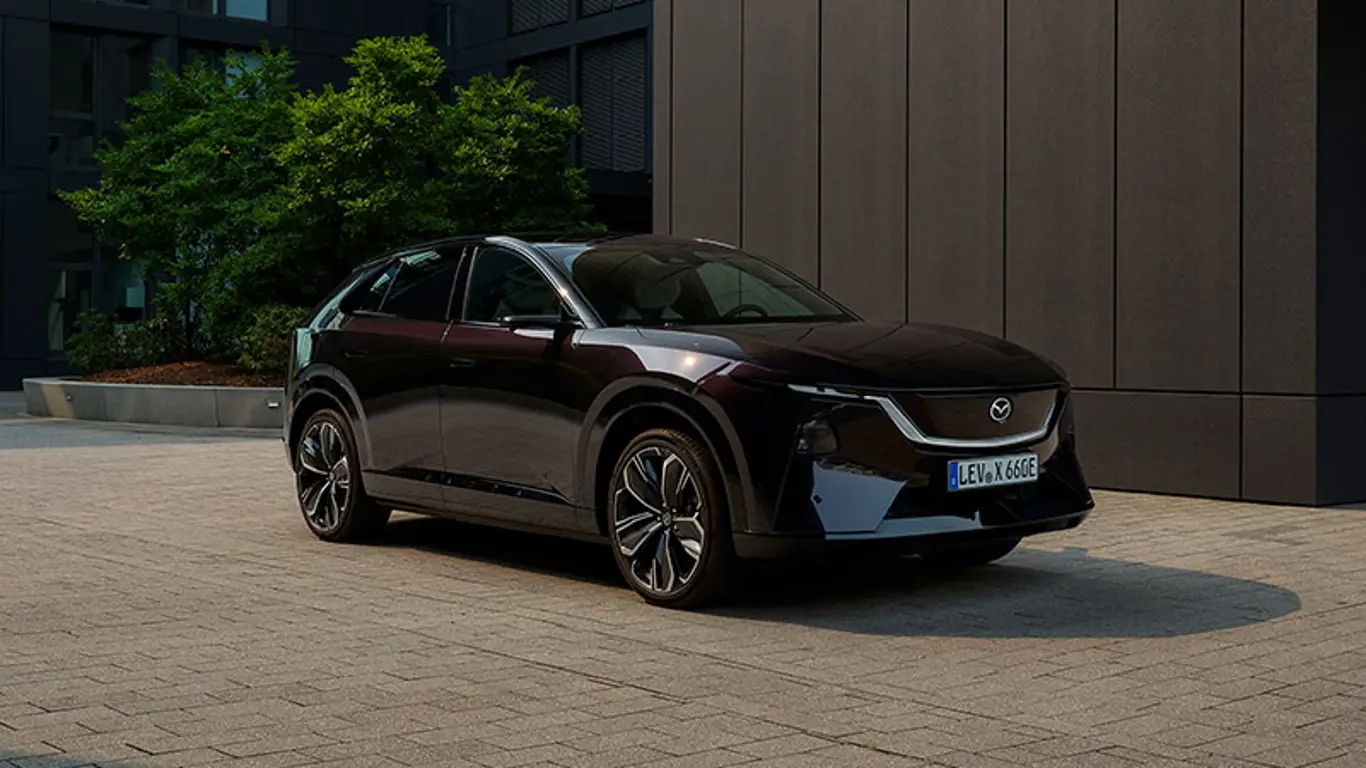

Chinese hardware, a Japanese badge and tuning for the German autobahn — now the Mazda CX-6e finally has to prove there is substance behind the polished promises. The electric crossover has moved from months of teasers to full European road tests and showroom appearances. On paper, the recipe is familiar: 258 hp, rear-wheel drive, a 78 kWh LFP battery and up to 484 km on the WLTP cycle. But the first real drives have exposed details that never appeared in the glossy specifications.
Start with charging. Mazda Motor Europe now quotes a maximum DC rate of 200 kW and a 10-to-80% recharge in about 24 minutes. Back in January, the figure was 195 kW. The difference is small, but telling: the final European specification is slightly stronger than the early one.
Mazda Motor Europe President Martijn ten Brink said: “The new Mazda CX-6e brings our human-centric approach into the electric era, combining outstanding design, driving pleasure and advanced technology in a distinctly Mazda way. Developed through close collaboration between our teams in Europe, Japan and China, the CX-6e brings together Mazda’s strengths from around the world with a clear understanding of what European customers expect. With its character and driving dynamics specifically adapted to European roads, it is an important addition to our line-up and another step forward in our multi-pathway approach to electrification.”

This is where things get interesting. The CX-6e faced its first serious test of the European chassis tune on a German autobahn. In a road test published on September 3, Vezess journalists pushed the electric crossover to its claimed 185 km/h top speed. The car did not flinch: testers praised its high-speed stability, limited body roll and comfortable suspension even on 21-inch wheels. Better still, the remaining-range estimate did not suddenly collapse after the fast sections.
But engineers did not manage to turn the Chinese architecture into a completely European car. The turning circle is a hefty 12.4 m, something city driving will expose quickly. The lane-keeping and speed-warning systems were also judged overly intrusive. And the Takumi Plus digital mirrors drew an even sharper criticism: the camera displays made it harder for journalists to judge the distance to nearby vehicles. High-tech? Yes. Better than a conventional mirror? That is still up for debate.
In Germany, the CX-6e starts at €49,990 in Takumi trim and €52,990 in Takumi Plus.
So Mazda has clearly brought more than a rebadged Chinese electric crossover to Europe. The first drives suggest the chassis really was retuned for fast European roads, and that work can be felt on the autobahn. But head into town and the turning circle, interfaces and some electronic assistants quickly remind you where the underlying architecture came from. The big question now is how good the CX-6e is away from a launch event and in everyday use. Full independent tests of energy consumption and real-world range should provide the answer — something the short presentation route could not measure objectively.