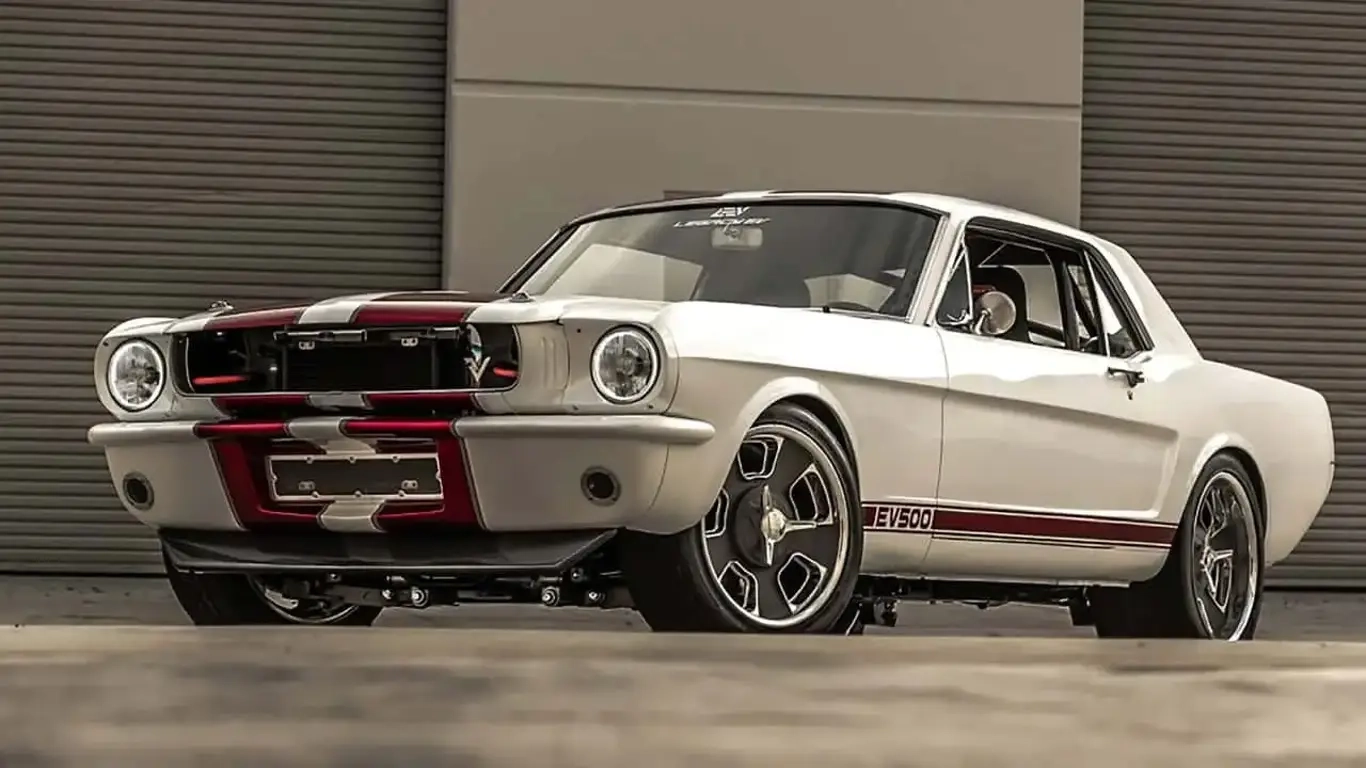

California-based Revolt Systems has unveiled one of the most striking EV conversions in recent years—a 1965 Ford Mustang powered entirely by a Tesla electric drivetrain. Originally built as a demonstration and test vehicle for new projects, this classic American muscle car has been transformed into a high-performance track machine. It retains its vintage appearance while gaining a radically different character.
Under the hood now sits a modified Tesla Model S Large Drive Unit, mounted on the original LS engine mounts. The high-voltage battery is positioned beneath the floor and partly in the trunk, achieving a near-perfect 50:50 weight distribution—something unattainable in the original Mustang. However, integrating the battery and electric motor required significant modifications to the floor structure and transmission tunnel.
The electric motor delivers up to 600 horsepower with a fully charged battery. To maximize track efficiency, the drivetrain incorporates a Torque Trends 1.9:1 reduction gear, effectively doubling wheel torque. The car's new performance character is supported by adjustable QA1 coilovers and an upgraded Baer braking system with 12-inch rotors, four-piston calipers, and regenerative braking.
But the project has one drawback: under high load, voltage can drop to as low as 100 volts when the battery is partially discharged, reducing peak power output. Revolt is already developing its own battery system designed to maintain stable voltage even during aggressive driving.
The electric Mustang first appeared at SEMA in 2021, but development has continued since then. Engineers have been refining cooling solutions, power components, and even testing alternative transmissions. A briefly installed 6XD sequential gearbox proved too harsh for the standard Tesla half-shafts and was subsequently removed.
This project demonstrates how EV technology can fundamentally transform classic cars, turning them into modern high-tech platforms without sacrificing visual authenticity.