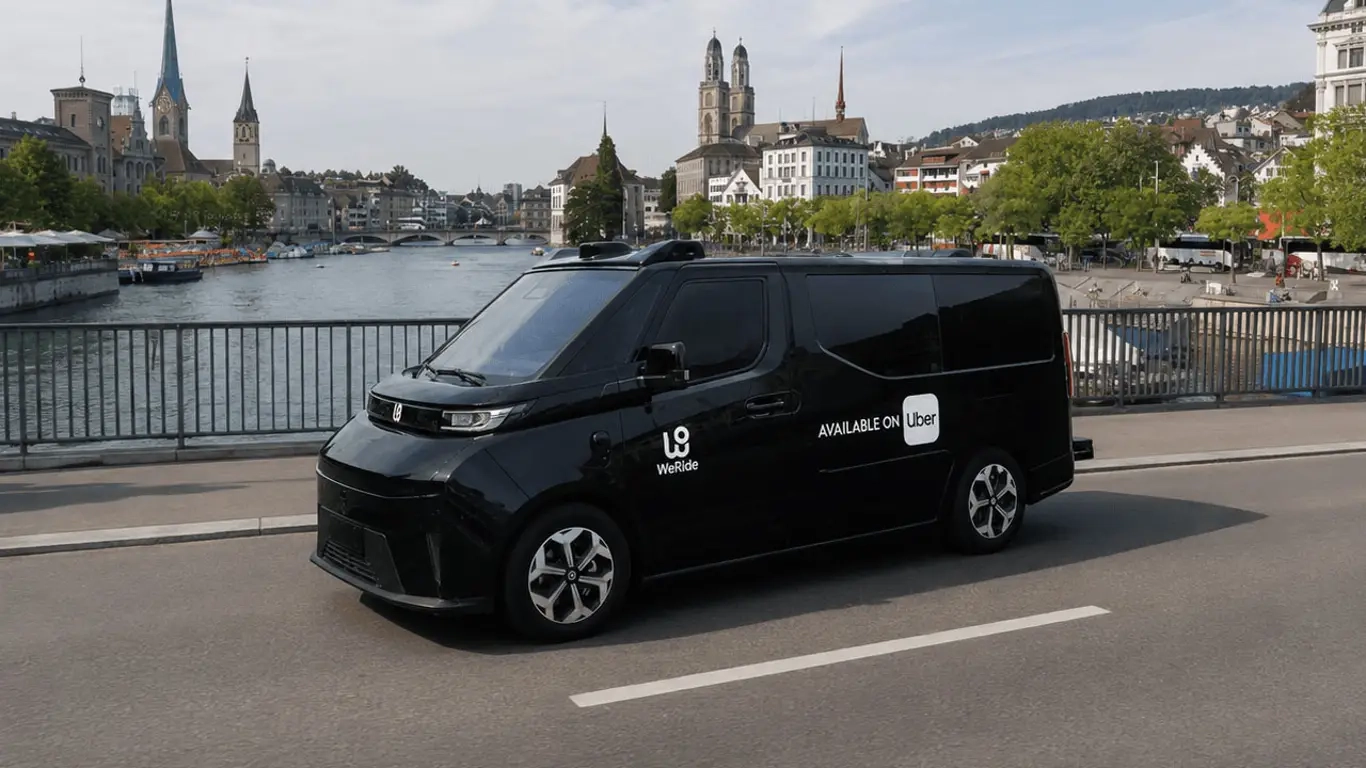

Switzerland rarely plays showcase for Chinese tech. But Uber and WeRide just picked Zurich for their first commercial robotaxi launch in the country — and the second European announcement in two weeks, right after Madrid. This isn’t a sandbox pilot anymore. It’s a play for one of the strictest, priciest mobility markets in the region.
Day-to-day fleet operations will be handled by Rydera, a local mobility operator picked to fit WeRide’s asset-light strategy. The Swiss ground isn’t foreign to the Chinese company anymore: in November 2025, WeRide secured a driverless permit from Switzerland’s Federal Roads Office (FEDRO) for the Furttal region, and its autonomous Robobus has been shuttling Zurich Airport staff between gates since the summer of 2025. Now Uber slots into that infrastructure — not as a hardware shop, but as the platform with the familiar app, ready demand, and city-scale dispatch experience.
For riders, the story is simple. You hail a driverless car through the same app you already use — provided FEDRO signs off on the final go-live. For Uber, the logic is just as clean. The company isn’t betting on one in-house stack; it’s assembling a roster: WeRide for parts of the world, Waymo in the U.S., separate projects with Volkswagen and others. If one partner stalls on approvals, the platform keeps moving with another. Risk, neatly spread.
But Zurich is no easy stage. Dense traffic, trams, cyclists, complex junctions, pedestrians, and a famously unforgiving attitude toward safety will quickly reveal how well robotaxis adapt outside China and the Middle East. In Abu Dhabi or specific Chinese zones, scaling is easier in controlled conditions. A European city demands different precision — and a different kind of regulatory trust.
Competition in Europe is only warming up. Waymo is still tiptoeing outside the U.S., Baidu’s Apollo Go is eyeing foreign markets, Tesla keeps promising robotaxis through its own ecosystem, and Volkswagen is prepping autonomous ID. Buzz vans for Uber in the States. The WeRide–Uber duo has one straightforward edge: the Swiss permit is already in hand, and the partner shows up with a ready customer base. Zurich becomes the 5th city out of the 15 promised under the broader Uber–WeRide deal.
For the average driver, this isn’t a replacement for a personal car yet — it’s a test of a new city service. If robotaxis end up cheaper, more available at night, and steadier on wait times, they’ll quickly absorb short trips. If pricing stays high, the service area stays narrow, and a safety operator still has to sit inside, the effect stays mostly cosmetic.
Zurich plays the role of a showroom here. If autonomous taxis can move calmly through a Swiss city, the technology earns a powerful argument for Madrid, Paris, Munich, and the rest of Europe. Robotaxis don’t sell speed first. They sell trust. And that’s exactly what WeRide and Uber will now have to earn on European streets.