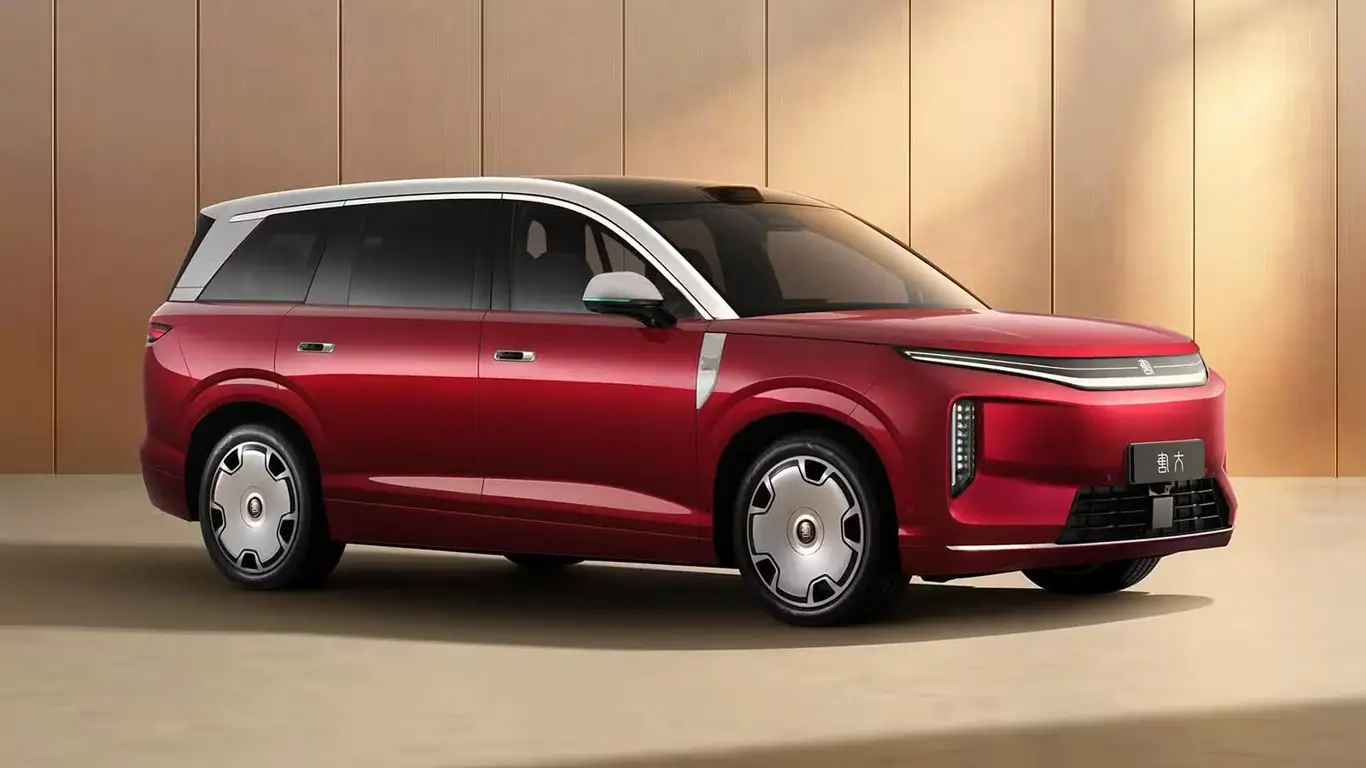

BYD has rolled out the Da Tang EV — the first D-segment flagship SUV in the Dynasty lineup. And it did so harder than anyone expected: the car landed below its own pre-sale corridor and dropped straight into the most cutthroat slice of the Chinese market — large family electric crossovers between 250,000 and 310,000 yuan. Right where Li Auto, Aito and Denza live.
Prices start at 239,900 yuan — roughly $35,500 at current rates. The 950 km range version is 269,900 yuan, the all-wheel-drive 850 km variant is 289,900 yuan. The top trim costs 309,900 yuan. Before launch, BYD itself floated a pre-sale window of 250,000–320,000 yuan. The final price tag undercuts expectations — and that clearly wasn’t an accident.
The Da Tang EV is large even by Chinese standards: 5263 mm long, 1999 mm wide, 1790 mm tall, with a 3130 mm wheelbase. The cabin seats seven in a 2+2+3 layout: zero-gravity seats up front, separate “captain’s chairs” in the second row. This isn’t just a family SUV. It’s BYD muscling into territory where buyers already expect a whiff of premium.

The hardware plays in the premium tier too. The entry version gets a second-generation Blade battery at 105.7 kWh, the rest run on 130.1 kWh. The 1000 V architecture and BYD’s “flash charging” tech push the battery from 10 to 97% in nine minutes. BYD claims 6,682 such stations are already up and running across 321 Chinese cities. If the infrastructure actually keeps up with sales, BYD has killed the single biggest fear of any large-EV owner in one move — long stops on the highway.
On power the Da Tang EV doesn’t hold back either. RWD versions push 300 kW or 370 kW, the AWD — 585 kW. The fastest does 0–100 km/h in 3.9 seconds, the RWD flagship in 6.2. Top speed is 250 km/h. On top of that: a twin-chamber DiSus-A air suspension with 100 mm of travel adjustment, rear-wheel steering with up to seven degrees of angle, a 5.2 m turning radius, and even a “crab walk” mode.
Then comes the real punch at the competition. A roof-mounted lidar comes standard, paired with the God’s Eye 5.0 driver assistance suite for city and highway. In China, buyers in this class no longer treat ADAS as a toy — they treat it as part of the sticker price. So the Da Tang EV doesn’t just lean on the battery: it throws in a big body, big power, fast charging, air suspension and serious electronics at a price point where BYD used to look hesitant.
Pre-orders have already topped 150,000 since the April 24 opening. For BYD this is a chance to climb above the mass-market segment and keep Li Auto, Aito, Onvo L90 and Leapmotor D19 at arm’s length. The interesting question now isn’t whether the Da Tang EV will land with buyers — the hype already speaks for itself. The question is whether BYD can build batteries and cars fast enough. Or will all this excitement turn into a six-month waiting list?