
Cupra is no longer just Seat’s sporty offshoot — and it just proved it in the most convincing way possible. Series production of the Raval has started at the Martorell plant, and for the brand this isn’t another EV launch. This is the first Cupra in history born entirely — from blueprint to assembly line — at a single site.
Nearly 160,000 m² of the factory has been reshaped for Raval. Line 1 got a brand new production process, more than 1,000 fresh robots and a completely retrained workforce. This isn’t “Seat’s sporty division” anymore — this is a full-cycle carmaker that designs, develops and builds its own cars. Among the headline upgrades: the PXL press, capable of stamping out 4 million parts a year. And on the bodywork line, the absolute inline measurement system is now live: four robotic cameras and six sensors check and calibrate body geometry right inside the production flow. A European first.
Massive Titan robots, 2.5 metres tall and rated for payloads of up to one tonne, mate the side panels to the chassis. The roof gets welded by a laser cabin that Volkswagen Group itself calls one of the fastest in the entire group. And this isn’t number-crunching for the brochure. For a mass-market compact EV, two things decide everything — geometric precision and assembly speed. They are exactly what determines how much the Raval will cost on the showroom floor.
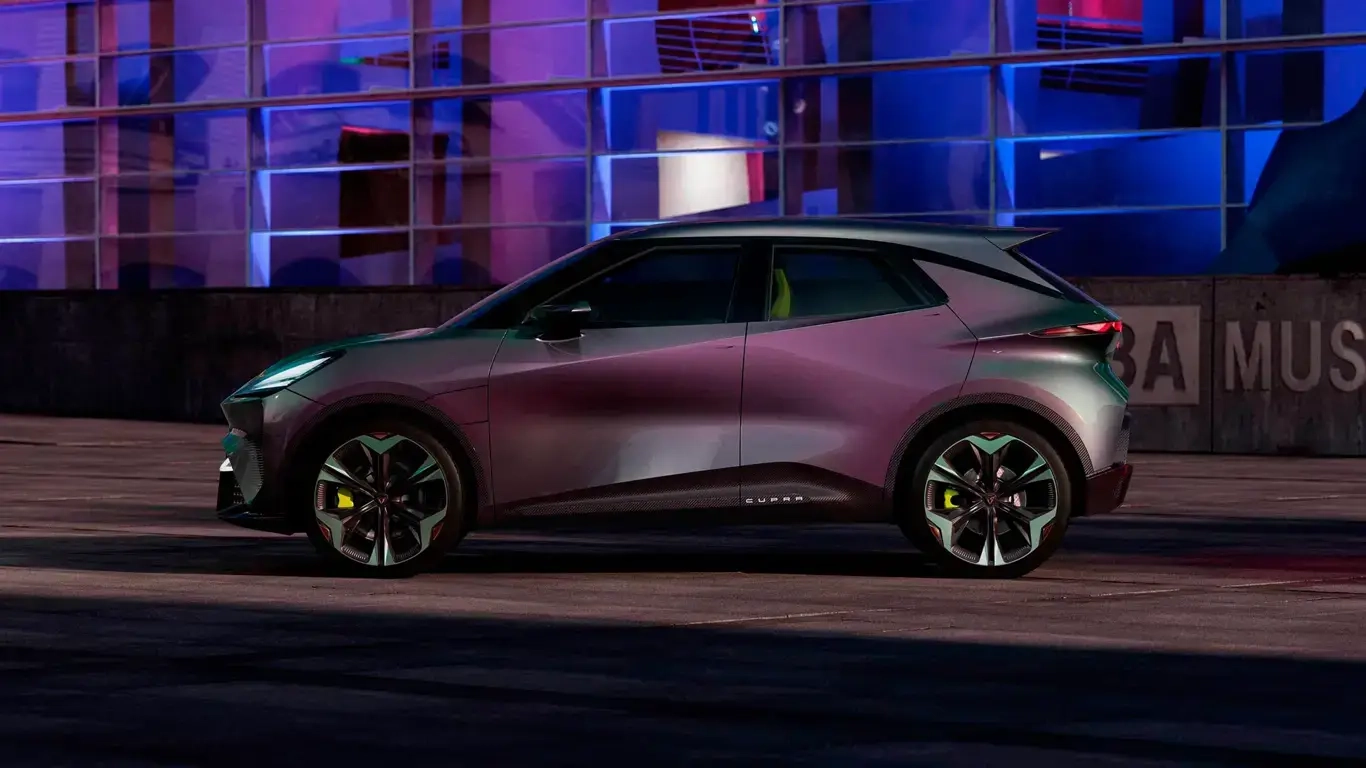
Painting has been rewritten too. The factory now has a KTL oven — the first all-electric oven at Martorell, running with zero CO₂ emissions in operation. That oven will apply the signature Iridescent Plasma and Manganese Matt finishes — the ones meant to visually separate Raval from every other model in the group. The battery is assembled at a neighbouring plant and travels roughly 600 metres along a covered bridge before meeting the platform and electric motor. Keeping the two sites that close cuts logistics costs and tightens quality control — absolutely critical for an affordable urban EV.
Raval is set to be one of Cupra’s key models for years to come. Its job isn’t just to widen the electric lineup. It’s a stress test — can a European plant build a compact EV fast enough and cheaply enough in an era when Chinese rivals are storming every front?
Martorell didn’t just get another order. It got a new identity. And the success of Raval won’t be measured in robots on the line. It will be measured by one question — can Cupra make a small electric car that is desirable and affordable at the same time?