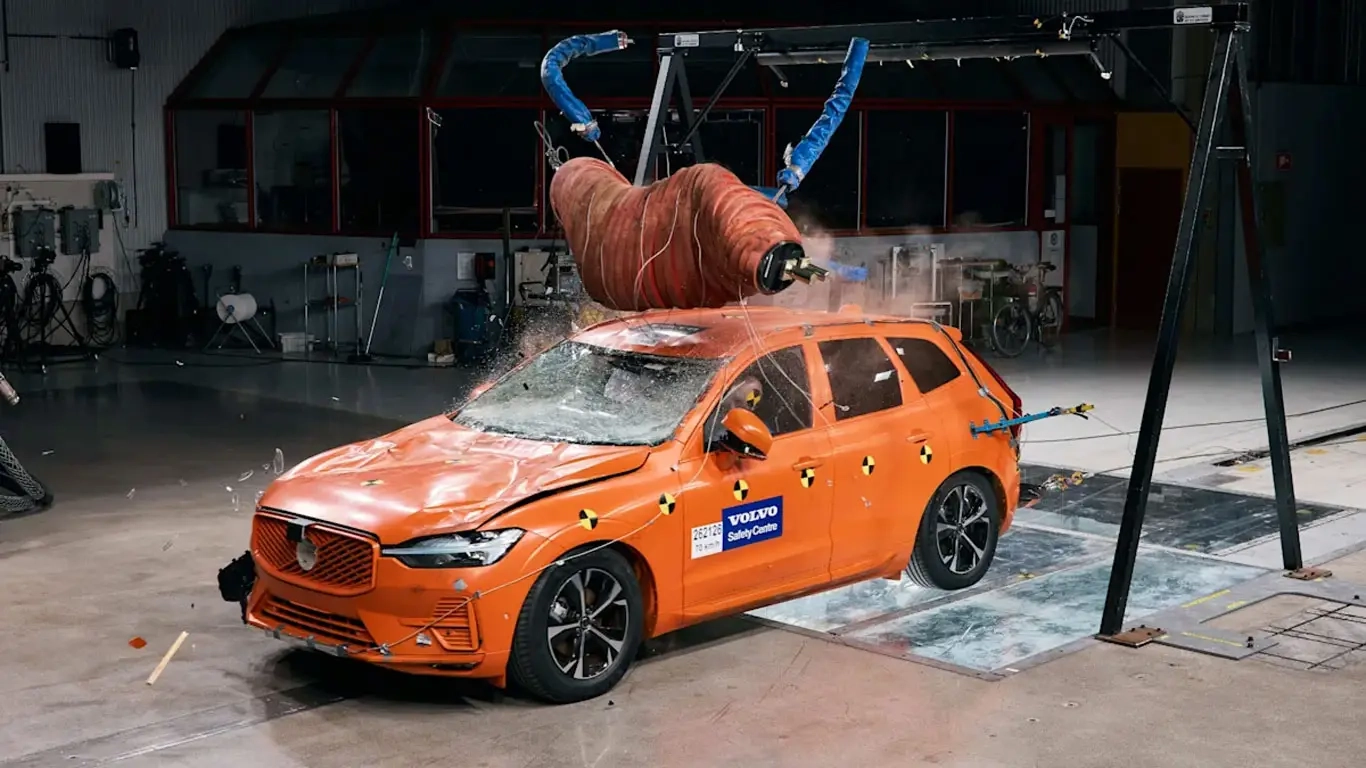

No staged press shots, no glossy parking-lot beauty. Volvo rolled an XC60 into a dim test hall, gunned it to 43 mph and drove it straight into a giant moose dummy weighing 793 pounds. The footage is the kind you rewind.
As Popular Science reports, the orange crossover moved through a deliberately low-lit room — engineers were recreating the conditions in which most real moose strikes happen: at night. Then the impact. The dummy’s legs buckle against the bumper. The heavy torso lifts onto the hood in a single motion, smashes into the windshield, rolls over the roof and flips through the air several times before crashing onto the asphalt behind the car. Glass shattered, but not breached. Cabin intact.
Why do this at all? Because a moose isn’t shaped like anything else on the road. Long legs, a heavy torso sitting high above the ground — the car sweeps the legs first, then the animal’s entire mass slams into the windshield and A-pillars. That trajectory is what kills drivers. That trajectory is what engineers have to absorb.
So the Volvo dummy looks nothing like a showroom replica. No head, no antlers, no fur — pure engineering. 114 rubber discs threaded onto steel cables and tubes, built to mimic exactly the right mass distribution: light at the bottom, heavy on top, the correct inertia. The goal isn’t realism, it’s impact mechanics. According to Volvo, only two such dummies exist anywhere in the world — and both are in Sweden.
For the Swedes, this isn’t engineering vanity. It’s grim statistics. Sweden alone logs roughly 5,000 car-versus-moose collisions every year. In the United States the number runs into the millions — 1 to 2 million crashes with large animals annually. Which is why Volvo keeps reinforcing the A-pillars, the roof, the windshield mounting zone and the entire upper body structure — the parts that take the hit when a moose travels over the car rather than through it.
One more detail. The dummy weighs 360 kg — that’s a fairly modest adult moose. The biggest bulls in the wild push past 680 kg. So what you see in the clip is far from the worst-case scenario.