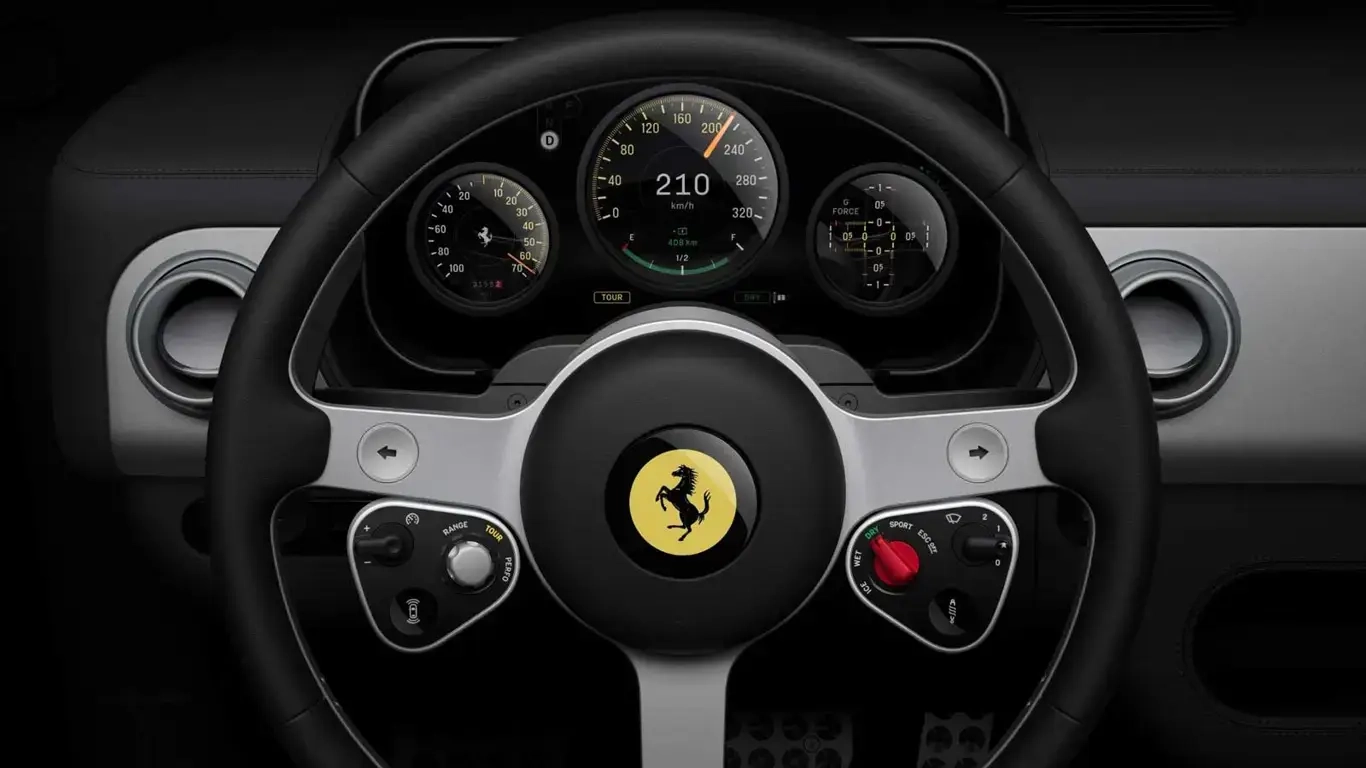

Ferrari Luce looks to stand out not just with its bodywork and electric powertrain. Inside the brand's first EV, a unique Samsung display system pairs digital graphics with real physical needles that pass directly through OLED panels, reports PEPELAC.NEWS.
It's a pivotal step for Ferrari. While most EVs today turn their interiors into flat-screen arrays, the €550,000 Luce is expected to retain the feel of a premium mechanical object. That's why the cockpit doesn't rely solely on screens but uses a multilayer setup blending analog elements.
Samsung Display will supply four panel sizes: 12.9, 12, 10.1, and 6.3 inches. The most complex setup sits in front of the driver. The instrument cluster combines two OLED screens: the lower 12-inch unit handles the background, scales, and indexes, while the upper 12.9-inch panel features three round cutouts. Physical needles pass through these openings, creating a depth effect instead of the typical flat display behind glass. This design uses HIAA (Hole In Active Area) technology.
Samsung already uses a similar approach in its smartphones for front-camera cutouts, but here the scale is much larger—the panel cutout is roughly 20 times bigger than a typical selfie-camera hole. In the Ferrari, it's not for a lens but for a mechanical component meant to inject analog life back into the digital dashboard.
The center console also gets a 10.1-inch OLED display capable of showing customizable features like a clock, stopwatch, and compass. Three physical needles pierce this screen as well, mimicking a classic chronograph. Rear passengers receive 6.3-inch panels for climate control, ride data, and other functions.
The Luce interface effectively sums up the car's philosophy: Ferrari isn't simply swapping the engine for a battery; it aims to fuse cutting-edge electronics with the brand's familiar tactility. Perhaps the most distinctive sound in this EV won't come from outside, but from inside—the quiet sweep of a real needle across an OLED screen.