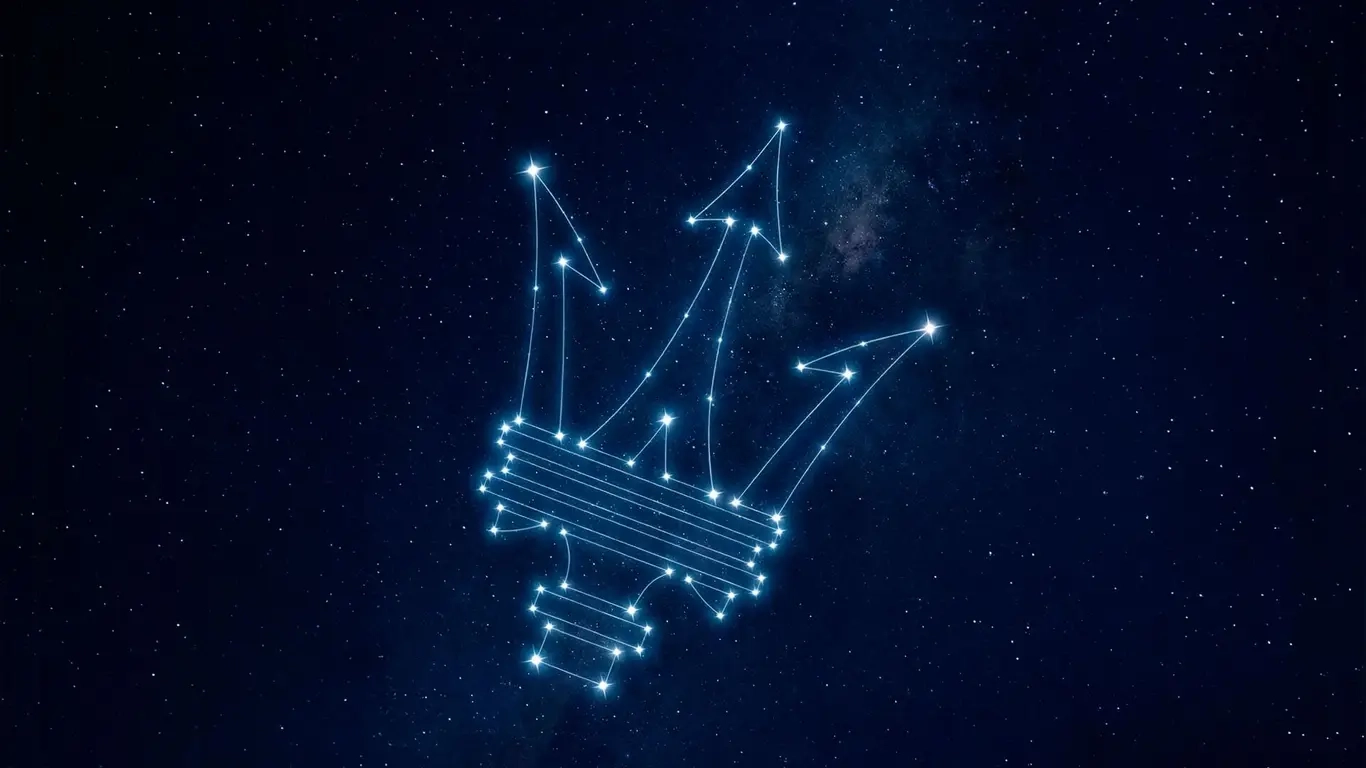

Maserati sent its Trident into space — and it did so literally. In the year the legendary emblem turns exactly 100, the Italians have unveiled the Trident Stars initiative, turning the brand’s logo into a real constellation in the night sky.
The logo’s story began in 1926: that was the year the Trident first appeared on the racing Tipo 26, which went on to win the Targa Florio in the very same season. A century later, the brand decided the milestone deserved more than a routine ad campaign — it deserved a place among the stars, quite literally.
The new constellation is made up of 100 stars — one for every year the emblem has existed. It sits between the constellations of Leo and Boötes, and the stars themselves are arranged to trace the outline of the Trident. The project was developed with researchers from INAF — the Astronomical Observatory of Padua, Maurizio Pajola and Anna Lucchetti.
Each star is dedicated to someone who has helped shape Maserati’s history: loyal customers, employees, collectors of classic models, owners of Maserati Fuoriserie cars, brand ambassadors and gentleman drivers who take the GT2 and MCXtrema to the track. And here’s the most intriguing part — every star has a double nature. Its digital twin is secured on the blockchain via a smart contract, while its physical counterpart comes with a certificate for a real star out in space.
In parallel, Maserati has overhauled its online configurator — and done so on the same grand scale. 3D environments, widescreen visuals in cinematic 21:9, photorealistic rendering. The car no longer hangs in some faceless neutral void; instead, it becomes the hero of scenes steeped in Italian style and luxury. Colours, materials, finishes, personalisation details — all of it can now be examined the way you used to be able to only at a dealership.
A hundred years ago the Trident first gleamed on the bonnet of a racing car. Now it gleams in the sky. Coincidence? Hardly.